06 May 2009

More Funny Found Science

Man, colloquia abstracts are a seemingly endless source of buried jokes. Check out the grad student dig in the following summary of a talk on using machine learning to study human and animal learning:

Machine learning studies the principles governing all learning systems. Human beings and animals are learning systems too, and can be explored using the same mathematical tools. This approach has been fruitful in the last few decades with standard tools such as reinforcement learning, artificial neural networks, and non-parametric Bayesian statistics. We bring the approach one step further with some latest tools in machine learning, and uncover new quantitative findings. In this talk, I will present three examples: (1) Human semi-supervised learning. Consider a child learning animal names. Dad occasionally points to an animal and says "Dog!" (labeled data). But mostly the child observes the world by herself without explicit feedback (unlabeled data). We show that humans learn from both labeled and unlabeled data, and that a simple Gaussian Mixture Model trained using the EM algorithm provides a nice fit to human behaviors. (2) Human active learning. The child may ask "What's that?", i.e. actively selecting items to query the target labels. We show that humans are able to perform good active learning, achieving fast exponential error convergence as predicted by machine learning theory. In contrast, when passively given i.i.d. training data humans learn much slower (polynomial convergence), also predicted by learning theory. (3) Monkey online learning. Rhesus monkeys can learn a "target concept", in the form of a certain shape or color. What if the target concept keeps changing? Adversarial online learning model provides a polynomial mistake bound. Although monkeys perform worse than theory, anecdotal evidence suggests that they follow the concepts better than some graduate students. Finally, I will speculate on a few lessons learned in order to create better machine learning algorithms. (Source, but ultimately via Eric Howell on the Hacker Within mailing list.)


No exactly stand-up material, but I love that the guy was playful enough to put it in the abstract. I guess I shouldn't be surprised, though, given what I found on this project's spring 2009 schedule page. We actually had that same xkcd hanging in our office for a while.

05 May 2009

THW on the Radio

A couple weeks back, The Hacker Within's fearless leader Milad Fatenejad and I did an interview with Matthew McCormick of Hacker Public Radio. I got notification today that it recently went live. Aside from having to suppress the occasional wince at my usual longwindedness, I had fun re-listening and think it turned out pretty well. If you're interested in programming/computing or would just like to hear about what we're up to and why, you can check out the interview here (I had to download it). Thanks very much to Matt for his help as we continue to try to get the word out about the organization and its work.

30 April 2009

Some atoms? Some CHEMICALS?

I was looking up some citation information on a text I use a lot but don't have on me today when I stumbled across this wonderfully bizarre customer review on Amazon. Those of you familiar with Benedict and Pigford's Nuclear Chemical Engineering may find this especially funny, but I thought the prose was amusing enough that I had to share.

I'm always supportive of huzzah, but--as is so often the case--the bewilderment sets in when you try to parse the all-caps text. Also, I wonder if we might adopt prehaps as a new nuclear safety term for the means by which we prevent mishaps.

Enjoy:

But seriously folks, this is the MOTHER of nuclear chemical engineering novelas! If you plan on reading this book be prepared to BUCKLE UP because you're going for a RIDE. A ride to Nuclear Chemical Engineering LAND! Huzzah! What have we here? Some atoms? Some CHEMICALS? Prehaps this CHEMICAL SOUP ISN'T SO BAD AFTER ALL! BOKKO!


Here's the link.

11 April 2009

Another Sweet Google Tool

Three events recently converged to respark my interest in a little mini-project I tried to do some time ago:

(1) At yesterday's Python subgroup meeting of The Hacker Within, our resident Pythonista got me all excited about developing easy web applications in that language. I write a lot of Python for pre- and post-processing of nuclear fuel cycle systems data, but I've never done any web-related Python work except for fixing a bug or two in some Trac instances. Nico got me pumped about the prospect.

(2) I started helping the Diocese of Milwaukee with their new Website, for which we're using Google Sites in an attempt to improve the ease of collaboration and maintenance. I think Google Sites is pretty terrific, but it does have some limitations, and I'm interested in identifying some Google-compatible solutions. The Python-based Google App Engine seems like a promising direction.

(3) My friend Ryan re-activated pangramaday, which I've mentioned here before and is now available via Twitter (@pangramaday).

As it did during my short-lived interest in learning to develop Java Applets, the pangramist's quandary motivated a little mini-project a few steps more complex than Hello, World! and perfect for learning a new set of interfaces. And this time I can actually publish the result (such as it is), because the Google App Engine framework is just so frickin' easy to use.

So if for pangram-, crossword- or Wheel-of-Fortune-related purposes you ever need a list of words that all contain some given collection of letters, look no further than pangramhelper. It's currently both ugly and slow, but if my interest in learning these APIs doesn't wane too much, that may change.

It's actually kind of fun to enter random (or not so random--can you tell I'm getting ready for the Easter Vigil?) letters and see what you get:


You wrote:

Christos anesti

We found:

anchorites
characterizations
chlorinates
cinematographers
interscholastic
orchestrating
orchestration
orchestrations
overenthusiastic
rhetoricians
stenographic
theoreticians
thermodynamics


It only took a few hours and about a hundred lines of Python (and most of those are just longhand HTML inside of function calls). Seriously, check out the App Engine.

16 March 2009

Cross-posting: St. Francis Forum

I put an item up at St. Francis Forum that I figured I should post here as well:


I had the opportunity (at Bishop Miller's suggestion) to preach at St. Andrew's Episcopal Church in addition to St. Francis House a couple Sundays back. I wanted to post the sermon because I know that some folks who wanted to come couldn't make it and because I was getting lots of questions about the Harvey Cox book I mentioned (it's called Common Prayers: Faith, Family, and a Christian's Journey Through the Jewish Year).

Anyway, if you're interested, you can find the sermon here.

27 February 2009

Doctorow Did It!

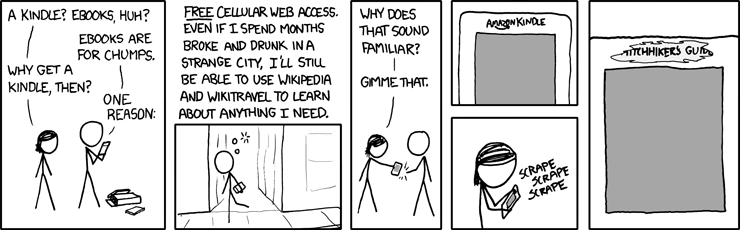
As I was catching up on my usual Web comics this morning (which were really on fire this week--see links in sidebar at right), I was especially amused by a thought that occurred to me when reading Wednesday's xkcd. If you've seen Cory Doctorow's excellent essay "Wikipedia: A Genuine H2G2—Minus the Editors" in the mostly disappointing The Anthology at the End of the Universe, you realize this comic's basically already been written. Have you seen that "Simpsons did it" episode of South Park? I couldn't help wondering if Randall Monroe has similar visions of Doctorow always one step ahead of him. Then again, in the case of those two, the idea-borrowing goes both ways.

Anyway, great comic anyway, as usual. Image courtesy xkcd.com and used by permission:


P.S.: I hate to badmouth anything DNA-related, but, seriously, The Anthology at the End of the Universe pretty much sucks. The notable exceptions are the Doctorow piece and the brilliant and hilarious "The Secret Symbiosis: The Hitchhiker's Guide to the Galaxy and Its Impact on Real Computer Science" by Bruce Bethke. I work with these people--it's all true.

P.P.S.: I'm sure other people have pointed this out on the xkcd forums, but in my opinion the scraped away Kindle logo should have yielded "Don't Panic." It's an inside joke anyway--why not get it right?

23 February 2009

Rave Within A Rave

My colleague David Meerman Scott just posted one of the coolest projects I think he's done: a video in which he hopes to demonstrate the power of and principles for creating what he calls a World Wide Rave by starting one around his new book of same name. I do editorial work for David and was involved in both the book (available from Wiley on March 3) and the new e-book (in which he explains how he put the video together), and I highly recommend that anyone interested in raising the online profile of his or her organization have a look at what he's put together. Watch carefully during the first few seconds!


18 February 2009

Another Bootcamp

For those interested in computing, The Hacker Within will be doing our second bootcamp of the semester in a few weeks. See below for details (flyer by Katy Huff, our talented Director of Creative Affairs):

14 February 2009

New Insights Posted

I mentioned in the last post that I'm taking over as the editor of the Engineering Learning Center's Teaching and Learning Insights newsletter for the semester. Just thought I'd mention that the February issue (which I did the markup and some light editing for) is posted at insights.engr.wisc.edu. I wrote an article for TLI last year and am looking forward to getting started on some articles for the March issue soon.

09 February 2009

The Difference Is Maintainability

So I write a lot of Python, and one of the claims promoters of the language usually make is that it helps you write more maintainable code. I think they're right in that claim, and I think they're right to stress the centrality of the issue.

We've discovered over the years at St. Francis House (and in my research group, for that matter, and at Wisconsin Engineer, if I remember correctly) that maintainability is also essential--and difficult--on the Web (of course, this is really just another kind of source-code-maintenance problem). In a high turnover organization, it's especially hard to cultivate a continuous Web presence.

Say what you will about the low-powered solution offered by Google Sites, I think they're on to something, and I'm super-excited that we've ported the St. Francis House website over to this system. Sure, I wish it were a little more flexible and powerful. But I think you'll agree that it lets you construct reasonably attractive and well organized sites (nearby St. Andrew's uses the system as well), and I can attest to the relative ease of use over other options (and I like screwing around with webpages and have learned a lot about XHTML/CSS in preparation for taking over for the semester as editor of this site about engineering education). Most importantly, no FTP or SCP is required (we computer geeks take these tools for granted, but I think they can be just as much a barrier as HTML).

I think Google's got another winner here, at least for a presumably significant market niche (groups who want a good site but can't afford to pay professionals, especially for maintenance and updating). I'll keep you posted as to whether the feature-set improves in the coming months.

02 February 2009

Holmes Slice

Just had to pass along a quick Oliver Wendell Holmes Sr. snippet that was the "Thought for Today" in Wordsmith.org's A.Word.A.Day email:

Laughter and tears are meant to turn the wheels of the same machinery of sensibility; one is wind-power, and the other water-power.

This is the same Holmes (father of the Supreme Court Justice) who brought us the wonderful "Wonderful One-Hoss-Shay" which Henry Petroski writes so thoughtfully about in To Engineer Is Human. Sounds like an interesting fellow.

03 January 2009

TV Plea

These days I watch virtually no television other than sports. There's nothing virtuous about this; I live three flights of stairs away from the set at our house, I'm busy most evenings and don't honestly have much chance, and--most importantly--I'm seldom able to find shows that I actually like.

Especially not on broadcast television, which is a shame. There's a great scene in Studio 60 where the eponymous show-within-a-show's network president is trying to woo a young writer who's created a drama about the United Nations and wants to take it to HBO. Knowing he once wrote an off-broadway play about Pericles, she appeals to Pericles's quote that "All things good should flow into the boulevard," the point being that she thought the show was too good to be tucked away on cable. I've always found that scene, and Sorkin's "glass tubes" ode to Filo Farnsworth in Sports Night, to be surprisingly moving. I can't remember what TV was like before cable, but I imagine it must have felt much more like a common experience than it does now.

Anyway, over the past two days I finally caught up with discerning TV watchers everywhere and caught Freaks and Geeks on DVD. It was, as a friend of mine once said of his not having read Infinite Jest, a point of growing professional embarassment. In my case, the profession isn't English literature--it's bitching about good TV shows always getting canceled. I have no legitimate claim to this profession (again, I am at best a failure and at worst a poser as a TV snob), but when your favorite TV shows are Sports Night, Studio 60, Arrested Development, Firefly, etc., it's hard not to take some kind of vocational interest in this high calling.

Aside from Studio 60, I didn't watch any of those shows while they were still on the air. And it seems to me that part of the fun of watching TV is blocking off a chunk of your week to get a little excited and to watch the new episode with friends. That's how I felt about Studio 60. It's how my dormmates and I felt as we treked to our buddy's house to watch Smallville each week during my freshman year. I can even remember my parents and I feeling that way about Star Trek: The Next Generation when I was a little kid in Florida. I think it's part of what's worthwhile about watching TV in the first place, and it prevents falling into the profoundly 2000s-era mailaise you get from falling in love with and then immediately having to say goodbye to a great cancelled-early show as you watch its entirety on DVD in grotesque marathon style (my eyes still hurt from last night's final Freaks and Geeks binge).

Here's my plea to the genuine TV snobs (or merely the very fortunate) among you on this Saturday morning: can someone please tell me which shows are that good right now? I don't have "Rock & Roll Lifestyle"-type aspirations of hearing of them first or anything. I just want to get to experience them the way TV was meant to be watched rather than in gloomy DVD postmortem. I don't read the Onion AV Club much much anymore (out of desperation to get some work done); please help me compensate and to have a genuinely positive TV watching experience, before it's too late. In the meantime, I guess I'll be tracking down the Undeclared DVDs.

23 December 2008

Give Us Some (Ecumenical) Music

If you're looking for a Christmas music special to watch tomorrow night, let me recommend "Voices of Christmas" on CBS at 10:30 Central. It was produced by the National Council of Churches and hosted by Michael Kinnamon, who I met a couple of months ago and who's a brilliant, caring teacher and theologian (I'm standing next to him in this picture in the back row at right).

In fine NCC fashion, the special presents music from a number of member communions, which I think will be a nice change of pace from more monolithic specials from a single tradition. I've been a little down on the church these past weeks (and it always gets worse when I get home and start getting sucked into watching cable televangelists--just change the channel, Kyle), so Kinnamon's closing remarks in the preview below were like a breath of fresh air. Also, I was pleasantly surprised to see my friend Cassandra pop up in the interviews. Nicely done, Cassandra!

20 December 2008

Two Beer-Related Recommendations

I met one of the hosts of WSUM's Beer Talk Today last night at a friend's housewarming party. Really interesting guy with fascinating insight into the local beer and food scene. Anyway, I checked out today's Year In Review episode and really enjoyed it. Consider it recommended; I've added a link to their blog at right, and you can also subscribe to the podcast on iTunes. FYI, their timeslot is apparently moving to Tuesdays at 9 p.m. when they return after the holiday break.

Speaking of recommendations, the beer that got us talking last night was New Glarus Brewing Company's new "Alt," a German altbier. A friend of mine happened to mention it to me a few days back, and the convenience store I stopped at on my way to the party happened to have it. Everybody at the party who had some raved about it, and I defnitely suggest that you add it to your holiday to-drink list. It's apparently not expected to last through December, so make haste.

19 December 2008

Another Ad: Be Like This Guy!


I was reading an article on yellowcake today in an old issue of the Journal of the Minerals, Metals and Materials Society, and I just had to pass on this hilarious advertisement for becoming a professional engineer (PE). Granted it's ten years old and directed at folks who already have engineering training, but I couldn't help but think it's small wonder that we're having a hard time getting people interested in being PEs if ads like this are thought to be a legit recruitment tool.

By the way, Samuel Florman writes about the issue of PE licensing and much more in a fascinating book called The Introspective Engineer that everyone with even a passing interest in the field should definitely consider reading. I found it helpful to have a historical perspective on why engineering school is as unpleasant as it is (speaking of poor recruitment strategies...).

Florman's also a PE, albeit a (slightly) cooler-looking one. What he really looks like, though, is Ed McMahon.

Florman:


McMahon: