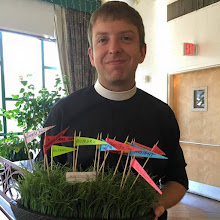
If you're looking for a Christmas music special to watch tomorrow night, let me recommend "Voices of Christmas" on CBS at 10:30 Central. It was produced by the National Council of Churches and hosted by Michael Kinnamon, who I met a couple of months ago and who's a brilliant, caring teacher and theologian (I'm standing next to him in this picture in the back row at right).
In fine NCC fashion, the special presents music from a number of member communions, which I think will be a nice change of pace from more monolithic specials from a single tradition. I've been a little down on the church these past weeks (and it always gets worse when I get home and start getting sucked into watching cable televangelists--just change the channel, Kyle), so Kinnamon's closing remarks in the preview below were like a breath of fresh air. Also, I was pleasantly surprised to see my friend Cassandra pop up in the interviews. Nicely done, Cassandra!
23 December 2008
Give Us Some (Ecumenical) Music


20 December 2008
Two Beer-Related Recommendations
I met one of the hosts of WSUM's Beer Talk Today last night at a friend's housewarming party. Really interesting guy with fascinating insight into the local beer and food scene. Anyway, I checked out today's Year In Review episode and really enjoyed it. Consider it recommended; I've added a link to their blog at right, and you can also subscribe to the podcast on iTunes. FYI, their timeslot is apparently moving to Tuesdays at 9 p.m. when they return after the holiday break.
Speaking of recommendations, the beer that got us talking last night was New Glarus Brewing Company's new "Alt," a German altbier. A friend of mine happened to mention it to me a few days back, and the convenience store I stopped at on my way to the party happened to have it. Everybody at the party who had some raved about it, and I defnitely suggest that you add it to your holiday to-drink list. It's apparently not expected to last through December, so make haste.
19 December 2008
Another Ad: Be Like This Guy!

I was reading an article on yellowcake today in an old issue of the Journal of the Minerals, Metals and Materials Society, and I just had to pass on this hilarious advertisement for becoming a professional engineer (PE). Granted it's ten years old and directed at folks who already have engineering training, but I couldn't help but think it's small wonder that we're having a hard time getting people interested in being PEs if ads like this are thought to be a legit recruitment tool.
By the way, Samuel Florman writes about the issue of PE licensing and much more in a fascinating book called The Introspective Engineer that everyone with even a passing interest in the field should definitely consider reading. I found it helpful to have a historical perspective on why engineering school is as unpleasant as it is (speaking of poor recruitment strategies...).
Florman's also a PE, albeit a (slightly) cooler-looking one. What he really looks like, though, is Ed McMahon.
Florman:
McMahon:


18 December 2008
Another Hacker Within Ad

09 December 2008
Hacker Within Meeting Friday
I doubt I have too many UW-Madison computer geek readers who don't already know about this (if indeed I have any at all, which is also doubtful given my dire posting record of late), but on Friday at 2:15 in 414 Engineering Research Building, the Hacker Within computational science interest group that a few of us started this summer is going to be hearing from Tim Tautges:
Component interfaces or APIs should a) have the right level of abstraction, so they can handle new kinds of data without needing to be modified, and b) should be callable from multiple languages, and c) should not get in the way of good performance. I'll describe the ITAPS mesh interface, which has been designed to meet these constraints.Sound cool? More importantly, does this look cool?:

If so, you should come by. What better way to celebrate the end of the semester? ;)
19 November 2008
Worlds colliding
So, my friend and colleague David Meerman Scott has a new book coming out. As you can see, he's collecting pictures of the promotional poster hanging in people's offices, etc. I sent him my contributions today and just had so share, such was the glory of the juxtaposition. The first is boring old me sitting in my boring old office, computer screens ablaze (surprisingly enough, it looks like I'm actually getting some work done). The second one is me in the lab that a bunch of my classmates work in. That's the Inertial Electrostatic Confinement experiment behind me, a project of our department's Fusion Technology Institute. The IEC group does not endorse the content of World Wide Rave; they were, however, nice enough to let me get a shot with their gear. Anyway, I can't wait to see what David's got up his sleeve. Should be exciting.
Office photo
Lab photo
If you're surprised to see me in decent clothes, you're not alone. The reason is that I had to give a talk earlier in the day to some visitors from the University of Tokyo. I haven't talked much about my research here lately, so I posted the slides, IYI. Please note that although they should stand alone (legitimate thanks, Michael Alley and Co.), these slides do look a little mangled depending on what you're viewing them with (sarcastic thanks, PowerPoint 2007). Rest assured that I'm not a total moron when it comes to font choice.
As a general PowerPoint PSA, I suggest you also check out Tufte's rant about it--mostly because it's hilarious.
Update: Here's the photo on David's WWR page.
04 November 2008
It's hip to be genuinely square
Just in case the blogosphere fails to produce any non-election-related material today (an absurd notion, of course, but do me a favor and grant the damn premise), I wanted to pass along an article my friend Erica posted recently: "Hipster: The Dead End of Western Civilization."
Don't get me wrong, I hate the "oh, kids these days" mentality. I hate it in the middle third of Alan Bloom's The Closing of the American Mind, I hate it when it rears its head periodically in the composition literature (every ten years or so, if I remember a couple of writing center scholars' talks correctly), and I hate it because I hate being referred to as a kid.
So apologies in advance for sending along what is essentially a "kids these days"-style rant. That said, it strikes me as pretty much the most wickedly fun rant I've read since Jon Pareles declared Coldplay "the most insufferable band of the decade." It also strikes me as true, but I would appreciate some insight from anyone who understands the situation better and can deliver me from what I suspect is an oversimplified view. Genuineness and originality are out there somewhere, right? Hipsters, help an engineer out.
19 October 2008
Miscellaneous Updates
Let me surface from my digital dormancy (which one of these days I'll get around to writing a post to explain) for a couple of quick updates.
First, I went with some other UW-Madison folks to UW-Platteville Friday for a conference of the North Midwest region of the American Society for Engineering Education. We didn't stay for the evening banquet and keynote (nor obviously for the second day of the conference), but a lot of what we saw was interesting and encouraging. I was especially intrigued by Haiyan Zhang's paper "A Model-Based Multidisciplinary Correspondent Methodology for Design-by-Analogy" and frankly touched by the important work reported in Dale Buechler's fascinating "An Electrical Engineering Program for Place-Bound Students: The First Two Years." If you're interested in our paper, which was about ASEE student sections, you can read it here.
Second, you may notice that the above URL points to a non-UW-Madison domain. I'm trying to get untied from doing all my hosting on UW computers, and as a consequence you can now find this blog at blog.kyleoliver.net. I gotta admit, it's going to take a little getting used to being a domain owner. One early bummer: Blue Host servers don't have svn installed. Still, I'm excited to have a reasonably sustainable option for implementing that Holy Grail of personal file organization: putting your entire electronic life under version control (which, as my friend Matt points out, gives you superpowers).
15 September 2008
DFW
Clark Terry apparently once said "Count Basie was college, but Duke Ellington was graduate school." I've felt the same way, since being introduced to the latter by a teacher and friend of mine a few years go, about Douglas Adams and David Foster Wallace.
In Wallace I found another author unafraid of the bold, if self-conscious, aside; he takes the sentiment in Adams's "if you don't want me to digress, then you may find that you are reading the wrong column" and compounds it to a state of near-manic (and hyper-honest) thread exploration and playful formalism. Fans of, in particular, Everything and More's "Small But Necessary Foreword" will know what I mean.
In Wallace I found another post-Snow polymath whose rangy prose didn't so much interpolate disparate disciplines as span them. These guys display first-class knowledge of a sickening variety of really challenging technical fields in addition to their obvious literary prowess. Ask Cory Doctorow or Richard Dawkins or James Gleick if you don't believe me--or just reread the middle third of The Salmon of Doubt or Infinite Jest's footnote 123, which are of approximately the same length.
In Wallace I found another thoughtful writing tutor and pointer-out-of-the-sublime. Wallace on Garner, Dostoevsky, and Federer and Adams on Rendell, Wodehouse, and Bach seemed at times to single-handedly (or would it be double-?) save me from the verbal and spiritual wasteland that is a college curriculum with only six humanities credits.
As I had with Adams, when I read Wallace I always thought: here's an author with whom I don't always agree but whose mind, though orders of magnitude more sharp, agile, playful, and generous than mine, at least seems to be organized in more or less than same way. Whose achievements, though light years beyond my reach, were somehow still embracing and empowering rather than intimidating and doubt-inducing.
The final parallel, of course, is that David Foster Wallace is, heartrendingly, also now gone. I somehow only found out a few hours ago. After my Douglas Adams mourning mostly ended, but as sadness that we'd never have new DNA books again remained, I'd occasionally console myself with the thought that at least the prolific Wallace seemed to have so much more to contribute. I have no doubt that he did. But this was a man who was chiefly concerned with forging unironic emotional connections with his readers, and, once you learned that, you didn't have to read very far to guess that he spent a lot of time in pain. To be honest, as someone who's grateful for both the joy and the sadness he shared with the world, I now take consolation mostly in the knowledge that he's free of that pain.
24 August 2008
They Can Fly Under Doors!!
I improved my batting average/Graydon Number/bat wrangling quotient to 2 BW in 4.5 BE (0.444) tonight. However, the incident was not without some startling revelations:
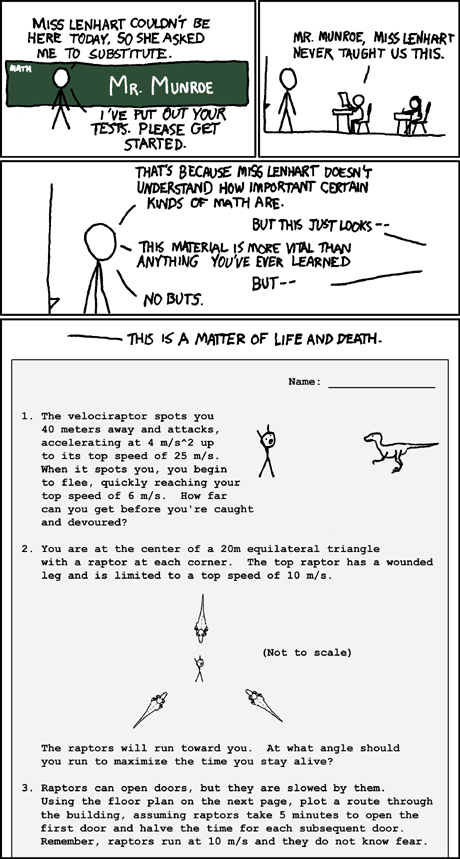
(1) My bedroom door is not protection enough. Seriously, I knew one was out in the hallway earlier, but I cleared its escape route (the bathroom opens out onto a fire escape) and closed all the other doors, so I figured I could get back to a few minutes of editing while I waited for him to exit. All of a sudden, the damn thing is back in my room! And now I'm alone with the bat in a small enclosed place. Awesome. I couldn't help being reminded of Question 3 ("Remember, bats fly at 10 m/s and they do not know fear").
I also learned that while they indeed seem to be very stupid, they apparently start to fly lower and lower as they exhaust their (still pretty ineffective) search for high altitude escape routes. How are we supposed to evade them if they're flying at crouching-level? As Colette pointed out earlier, we can't fly.
(2) Leaving the fire-escape door open apparently varies as an effective wrangling technique. It worked like a champ the other night, but tonight--despite not seeming to have had it open any longer than last time--I returned to the bathroom when the coast was clear to find it bat-less, but also an entomological menagerie. I've got so many damn bugs in my bathroom, I need to track down another bat just to get rid of them all. I feel a little like the old lady who swallowed a fly (what is the point of this video, incidentally?) but kinda in reverse. There's going to have to be a mosquito massacre in a few minutes.
Speaking of massacres, I'm seriously considering starting to take swings at them (the bats, not the bugs). I'm told that if you hit them you can stun them and then carry them away to safety in a plastic bag. The key, apparently, is to not swing too hard. But one bared its teeth at me yesterday when I was trying to shoo it away from its perch, so I'm not really interested in turning a swooping but seemingly non-combative flying mammal into one that perceives me to be attacking it. Frazzled and fanged is not an attractive combination, in my book. Thus, I'll be employing the Dan Uggla philosophy: swing hard in case you hit it.
Note to potential St. Francis House residents (or anyone who's afraid Colette, Hattie, and I are going to get rabies): We'll get to the bottom of this chiropteric conundrum. These bats have to be getting into the house more easily than in the past. We should be able to find the entry points and secure them.
Image: xkcd #135. Used by permission.
19 August 2008
Kyle Oliver: Bat Wrangler
For those of you who don't know, I now live at a church. An old church. One with bats.
I've decided the best way to cope with this less-than-ideal aspect of my otherwise wonderful living situation is to have a little fun with it. Watch my Twitter feed (reproduced at right and on my Facebook status) for updates to the bat wrangling quotient (aka Graydon Number or simply batting average), which is calculated by dividing the number of bats I manage to wrangle out of the house (bat wrangled, BW) into the number I encounter (bats encountered, BE, aka at bats).
Some notes:
(1) I've already learned that bat wrangling is (often necessarily, and I suspect also to our mutual advantage) a team sport. BW and BE numbers will be split among all participants in the encounter/wrangle. Thus my current bat wrangling quotient is 1 / 2.5 = .400, because tonight I added two solo encounters and one successful wrangle (don't know where the other one got off to) to my previous 0/0.5 record after Carl and I had an unsuccessful bat run-in last week. As you might expect, I'll report my stats baseball-style, i.e. "Current bat wrangling quotient: .400 in 2.5 at bats."
(2) Despite all the baseball language, I want to emphasize that all the blunt instruments (they're badminton paddles actually) on our floor are for self-defense only, and I'm not actually taking swings at them (the bats). The goal is to guide them out of the house, not knock them into oblivion Dan Lin-style.
(Sorry for mixing metaphors here. I've so far avoided bat-transmitted rabies, but I do have Olympic fever.)
Stay tuned for bat wrangling advice and tales of heroics...and probably also anti-heroics, as in my second at bat this evening, wherein I just shut the door to the TV room and went on watching hurdles and gymnastics.
Ned Yost Is A Big Honkin' Doofus
What the hell was C.C. doing batting in the eighth (and then pitching a long ninth) with such a huge lead last night? I know we're probably not going to be able to keep him, but we still gotta get him through hopefully a couple months' worth of baseball yet. Don't get me wrong, the guy has every right to keep himself in games and risk flushing millions of dollars down the drain in a contract year. But, rental player or not, we shouldn't let him be so hasty with his future, because it's our future too until after the season. Grrh.
10 July 2008
Writing Center Summer Institute
I got an email yesterday that the Writing Center Summer Institute, which is being held at UW-Madison this year, has a blog up and running. If you're familiar with writing center scholarship, then you know those names over in the "contributors" column are some of the best and brightest in the field. I've been exceedingly lucky to have briefly interacted with a couple of them at conferences and colloquia, and I'm excited that I'll get a chance to duck in and say hello in a couple weeks (my friend Erica and I are moderating a panel together during the Thursday session).
If you want to read what some really sharp, thoughtful people have to say about writing center work, check out this blog once the institute gets rolling, if not before.
06 July 2008
Gainin' On Ya! All Up Around Your Neck
The Cubs are in first place, in case you haven't heard. The Brewers are in second, "but that's a temporary condition too":
To each his reachAin't it funky, Chicago?
And if I don't cop, it ain't mine to have
But I'll be reachin' for ya
'Cause I love ya, CC.
Right on.
(Or how about "J.J.? C.C.; C.C.? J.J.")
All kidding aside, the Brewers now have arguably the best one-two starting pitching punch in baseball with, in no particular order, Ben Sheets and C.C. Sabathia. (Who am I forgetting? Surely a pair in the AL?) Sheets' ERA and WHIP are a little better this season, but Sabathia pitches in the AL, leads baseball in strikeouts, and is the reigning Cy Young winner (he also got off to an unusually bad start).
It's gonna be a fun second-half!
03 July 2008
Fade to Uninterestingness
Its overly reductive headline notwithstanding, this article from yesterday's New York Times basically sums up why I'm no longer so jazzed about a career in academia. I think the overarching theme emerging from these observations is less about a shift from liberal to conservative (or politically driven to "less explicitly political"), but rather from theoretical and big-picture-centric to relentlessly empirical and data-centric.
(Am I implying that the latter attitude obscures one's ability to see the big picture and actually say something interesting? Well, not necessarily, but it does for me personally. Do I especially care that the former attitude runs the risk of being less rigorously scientific? No, I do not.)
Anyway, here (for me at least) are a few particular sources of despair:
At the same time, shrinking public resources overall and fewer tenure-track jobs in the humanities have pushed younger professors in those fields to concentrate more single-mindedly on their careers. Academia, once somewhat insulated from market pressures, is today treated like a business. This switch is a “major ideological and philosophical shift in how society views higher education,” Mr. Schuster and Mr. Finkelstein write in “The American Faculty.”
[...]
Ms. Goldrick-Rab has embraced such experiments. A graduate course she created — partly based on her research of community colleges — focused on “educational opportunity and inequality” at community colleges, with an “emphasis on the critical evaluation and assessment of current up-to-date research.” [Admirable, but sadly boring to me in the absence of "grand frameworks": see below.]
Another Wisconsin professor, Erik Olin Wright, a 61-year-old sociologist and a Marxist theorist, described it this way: “There has been some shift away from grand frameworks to more focused empirical questions.” [Isn't the grandness what makes higher education exciting? Isn't it what teaches us that there's more to life than making money? Isn't it what helps us grow during these hopefully enriching years of our lives? Can we really be sustained by focused empirical questions alone?]
[...]Wisconsin is part of the state’s university’s system, for example, but it receives only 18 percent of its total budget from the Legislature. The rest comes from donations, foundations, federal research grants and corporations. Mr. Wright and Mr. Olneck worry how constantly having a hand out — particularly to corporations — may affect attitudes and policies. Mr. Olneck mentioned the long list of labs and classrooms named after companies like Halliburton, Pillsbury and Ford Motor Company.
The market sensibility may account for what Mr. Olneck and others call an increasing careerism among junior faculty members.
Part of why I find the headline a little unsatisfying is because of my personal position on this issue. Unlike so much of what's described in this article, I'm totally down with the trend away from polemics:
The authors are not talking about a political realignment. Democrats continue to overwhelmingly outnumber Republicans among faculty, young and old. But as educators have noted, the generation coming up appears less interested in ideological confrontations, summoning Barack Obama’s statement about the elections of 2000 and 2004: “I sometimes felt as if I were watching the psychodrama of the Baby Boom generation — a tale rooted in old grudges and revenge plots hatched on a handful of college campuses long ago — played out on the national stage.”
Another part of why I think the political theme here is confusing is the stuff about Allan Bloom:
Yet to some traditionalists, preoccupations like Mr. Olneck’s grated. The conservative philosopher Allan Bloom captured the bitter splits — better known as the culture wars — in his influential best seller “The Closing of the American Mind” in 1987. He detailed fights over the scarcity of women and people of color in the curriculum, the proliferation of pop-culture courses, doubts about the existence of any eternal truths and new theories that declared moral values to be merely an expression of power. These rancorous disputes often spilled into the nation’s political discourse.Even though he resented and disagreed with many of the fruits of old-guard liberal academic thinking ("old-guard" as defined in this article, of course, i.e. the baby boomers), I can't help but think that the part of Alan Bloom who was so concerned with the beauty of eternal truths would be unhappy about what Wright called above the "shift away from grand frameworks." I mostly hated COTAM, but I think Bloom and I could agree about the impoverished-ness of a purely data-driven academe. We need facts and the frameworks to understand them.
The absence of that balance reminds me of an interesting point of agreement between mathematical physicists Henri Poincaré and E. A. Milne that I wrote a few years back. I'm worried that what they describe sounds awfully familiar:
...both writers quickly dismiss the criticism that the essence of the scientific enterprise is mere fact gathering. Poincaré does so with an oft-quoted analogy to building: “Cannot we be content with experiment alone? No, that is impossible; that would be a complete misunderstanding of the true character of science…Science is built up of facts, as a house is built of stones; but an accumulation of facts is no more a science than a heap of stones is a house.” Milne also subscribes to this viewpoint. He similarly denies the notion that science “adopt[s] the spirit of the collector, and glor[ies] most in the increase in the frontiers of our knowledge of facts, in the assemblage of fresh phenomena in a tendency to completion and exhaustiveness.” He later notes the “deleterious effect” of such an attitude, claiming “It gives rise to sneers such as that of H. G. Wells, when he pictured the large majority of scientific workers as each of them merely ‘adding one or two to that large stock of little papers with blunted conclusions of which the world is already too full.’”
Finally, I'd claim that we can see the migration described in this article reflected in what I'll call the Comic Wars. Don't get me wrong, I love PHD, but I think the attitudes it usually reflects are symptomatic of the changes this NYT article is getting at. See, for example, this post from Natalia Cecire:
Piled Higher and Deeper appears to be the grad-student-centric web comic of choice. Unfortunately, PHD is all about engineers. The recent addition of a humanities grad student (Gerard, the medieval Scandinavian philosophy student) only drives home that the author of the comic knows almost nothing about the humanities, and considers disciplines legitimate only insofar as they are quantitative.Although I would have said "scientists and engineers," I'm totally with you, Natalia. In fact, one reason why I love xkcd is that it represents what to me is the ideal middle ground between and PHD and Dinosaur Comcis. That is (if I'm not stretching the analogy too much) between the idealistic, though ultimately perhaps a little naive previous model and the data-driven, capitalistic model that we seem now to be stuck with. To me, the old framework begs the question "Whither verification and quantification?", the latter, "Whither significance and inspiration and playfulness?"
On the other hand, there is Dinosaur Comics, which is pure brilliance.
As xkcd so often reminds me (here and here, for instance), I need both, for wholeness' sake. Let's hope academia realizes that it does too.

 Posts
Posts


